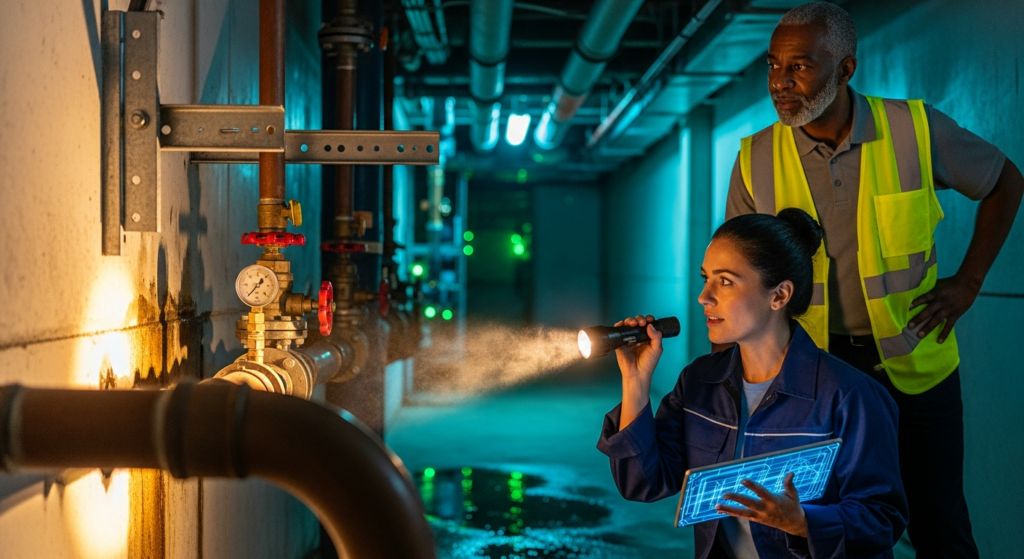
Water infrastructure failures result in the loss of 10% to 40% of treated water in Ontario municipalities annually. At the property level, a single dripping fixture wastes over 3,000 gallons per year. For real estate portfolio managers, undetected moisture leads to significant property devaluation and increased operating expenses. Modern diagnostics, including IoT and AI-driven detection, now allow for proactive rather than reactive maintenance.
The Financial Impact of Undetected Leaks
Hidden water damage is a leading cause of capital loss in facilities management. Data from municipal infrastructure serves as a benchmark for the risks faced by individual buildings.
Case Study: Infrastructure Failure Rates
Infrastructure data from Hamilton indicates that systemic issues are predictable:
- Ground Movement: Responsible for 60% of pipe breaks.
- Systemic Corrosion: Accounts for 33% of failures.
- Other Factors: Comprise the remaining 7%.
The cost of repair escalates based on the speed of detection. While a fixture repair typically costs under $200, a main line breach can range from $400 to over $3,000. Furthermore, with projected 10% annual water rate increases in various regions, the cost of wasted water continues to compound.
Identifying Surface Leaks vs. Structural Damage
Effective management requires distinguishing between minor mechanical issues and deep pipe failures. Waiting for visible moisture typically results in high remediation costs.
Indicators of System Failure
Property managers should monitor for the following warning signs:
- Acoustic Anomalies: Hissing or rushing sounds behind walls when fixtures are inactive.
- Pressure Fluctuations: A sudden, sustained drop in water pressure often signals a structural line compromise.
- Bill Spikes: Unexplained increases in monthly water utility costs.
- Environmental Signs: Persistent damp odors, warped flooring, or water pooling in parking areas.
For precise identification, a Hamilton plumber may utilize acoustic listening devices or thermal imaging to locate the source of a leak before initiating excavation.
Evolution of Diagnostic Tools
The industry is moving from manual inspections to continuous, automated monitoring. Traditional sensors often suffer from high false-positive rates because they rely on rigid, fixed thresholds.
Comparison of Detection Methodologies
| Methodology | Detection Mechanism | False Positive Rate | Primary Application |
| Traditional sensors | Fixed thresholds, direct moisture contact | High | Residential, small commercial |
| AI dynamic baseline | ML-driven historical analysis and variance detection | Low | Large commercial and industrial |
| Acoustic loggers | Sound wave amplification for high-frequency signals | Moderate | Underground municipal and commercial mains |
Modern systems utilize dynamic baseline analysis. By learning a building’s specific water-use patterns, these tools establish flexible thresholds that ignore normal fluctuations while remaining sensitive to genuine breaches.
2026 Technology Trends: IoT and AI
The 2026 technical landscape for leak detection is defined by connectivity and predictive analytics.
IoT and Edge Computing
- Zigbee/Thread Protocols: Wireless sensors connect to central management platforms to monitor high-humidity or hard-to-reach areas, such as basements.
- Freeze Protection: Wi-Fi-enabled sensors trigger alerts when temperatures drop to 4°C (39°F), preventing burst pipes.
- Cellular Backups: Floor sensors using cellular networks ensure alerts are sent even during local Wi-Fi or power outages.
Machine Learning and Imaging
AI algorithms now achieve up to 96% accuracy in mapping leakage zones by analyzing sensor data patterns. This reduces the reliance on manual surveying. Additionally, infrared thermal imaging allows surveyors to verify seepage behind walls non-invasively. For underground pipes, ground-penetrating radar is replacing traditional “trial-and-error” excavation by locating breaches through concrete and soil.
Strategic Property Maintenance
Protecting long-term asset value requires a transition to data-driven monitoring. Effective leak detection filters out environmental “noise” to provide actionable insights. For modern property managers, AI-driven systems are now a standard requirement for risk mitigation and cost control.