The bottom seal is the least expensive component on a garage door and the one doing the most work against the elements. It is a strip of flexible rubber or vinyl held in an aluminum retainer along the bottom edge of the door, and it is the only thing between the inside of the garage and everything happening on the driveway.
It is also entirely consumable. It is designed to be replaced, and it very often is not.
The Four Ways It Fails
Compression. Years of the door resting on it flatten the bulb, and it no longer expands enough to fill the gap. The test is the simplest one in the whole trade: close the door, turn off the garage lights, and look along the bottom edge. Any daylight is a gap, and the width of the daylight is the width of the gap.
Cracking. UV exposure and repeated cold cycling turn flexible vinyl brittle. It splits along its length or tears out of the retainer at one end.
Tearing. Ice bonds the seal to the slab overnight, and in the morning the opener lifts the door and takes a section of seal with it. This is the classic winter failure and it usually damages the retainer too.
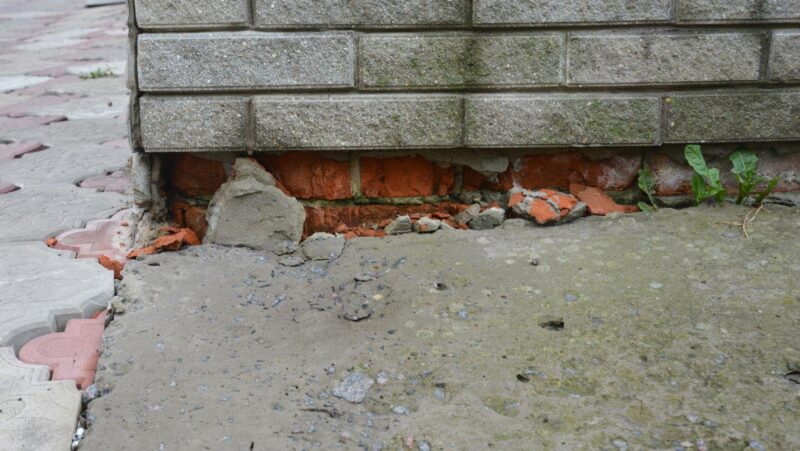
And the case people misdiagnose most often: the seal is fine but the slab has settled or heaved, and the door no longer meets a flat surface. Fitting a new seal here will produce the same gap within a season, because the seal was never the problem.
What the Gap Costs
The energy case is easy to picture. A 16-foot door with a half-inch gap across its full width is roughly eight square inches of permanent opening in the building envelope, open twenty-four hours a day. In an attached garage that opening is one wall away from conditioned space, and that shared wall is rarely insulated to exterior standard.
The water case is more expensive. Driveways that pitch toward the garage deliver every rainfall to that gap. Water on the slab wicks into anything stored on the floor, corrodes the bottom brackets and the lower ends of the lift cables, and in an attached garage reaches the sole plate of the shared wall. Repeated wetting there is how a cheap seal becomes a framing repair.
The pest case generates the most complaints. A quarter-inch gap admits mice. A half-inch admits rats. Anything at all admits insects, and since the garage is the least-inspected room in most buildings, a population establishes itself for months before anyone notices.
And there is a wear consequence that gets overlooked entirely. Grit and windblown debris entering under a compromised seal end up in the vertical track zone, where they contaminate roller bearings and accelerate wear across the whole assembly.
Getting the Right Seal
The seal slides into a retainer along the bottom of the door, and the retainer profile determines which seal fits. The three common profiles are T-style, bead-style, and U-style, and buying the wrong one is the most frequent self-repair failure. The second most frequent is buying a length too short for the full width of the door.
The retainer itself also wears. On older doors it is often bent, corroded, or partly torn away at one end, in which case the retainer needs replacing along with the seal or the new seal will simply pull out again.
Booking garage door bottom seal replacement as a scheduled item rather than a reactive one means the retainer condition, the bottom brackets, the cable ends and the slab contact all get assessed at the same time. That last check is the one that catches the uneven-slab case before a new seal is fitted and immediately ruined.
When the Slab Is the Problem
Where the concrete genuinely is uneven, a taller door seal is the wrong fix. It will compress unevenly, wear out fast, and leave the gap where the low spot is.
The right answer is a threshold seal, a bonded rubber strip fixed to the slab itself that the door seal closes against. It works with the existing door seal rather than replacing it, it accommodates an uneven floor, and it also functions as a water dam for driveways that pitch inward. It is the single best fix for a garage that takes on water in heavy rain.
The Rest of the Perimeter
The bottom is the largest gap but not the only one. Vertical weatherstripping runs along both jambs and a header seal runs along the top, and both fail in the same ways from the same causes.
Checking all three takes about two minutes with the lights off. Daylight anywhere around a closed door means the envelope is open there.
Put It on a Schedule
For a managed property or any home in a real winter climate, check twice a year: late autumn before the first freeze, and spring after it.
Late autumn is the important one. A seal that is already compressed or cracked going into winter will freeze to the slab, tear on the first cold morning, and generate an emergency call at the least convenient time of year, frequently taking a roller or a cable with it.
Replacing it in October is a maintenance line item. Replacing it in January, along with whatever else it damaged on the way out, is not.