The kitchen has evolved into one of the most dynamic spaces in the home. It is a place for cooking, gathering and, increasingly, socialising. Within this setting, tiles are not merely decorative finishes, but high-performance surfaces exposed to daily wear, moisture and temperature changes.
Choosing the right tiles therefore requires a balanced approach. Technical reliability, proportion and visual coherence must work together to deliver a space that is both refined and built to last.
Understanding performance requirements in a kitchen environment
The kitchen is subject to constant stress. Spills, steam, dropped utensils and frequent cleaning all test the resilience of surfaces. For this reason, performance should always guide the initial selection process.
For flooring, resistance to abrasion and scratches is essential. A dense, non-porous surface helps prevent staining from food, oil and acidic substances while ensuring durability under continuous foot traffic. Slip resistance is another important factor, particularly in family homes where safety cannot be overlooked.
Wall tiles, especially in backsplash areas, must withstand humidity and repeated cleaning. Easy maintenance is crucial. Surfaces that resist absorption simplify daily upkeep and maintain their appearance over time.
Finish also plays a decisive role. Matt or lightly textured surfaces can enhance grip on floors, while smoother finishes may improve light reflection on walls. Every choice should respond to the practical realities of the kitchen environment before aesthetic preferences take precedence.
Wall tiles or floor tiles? Defining the function before the style
Although visual cohesion is important, wall and floor tiles serve different purposes. Kitchen floor tiles must cope with weight, movement and impact. Their thickness, strength and technical rating should reflect these demands.
Wall tiles, by contrast, allow for greater decorative freedom. Backsplashes can introduce subtle contrast, texture or material effect without compromising functionality. However, practicality remains essential. Surfaces must be easy to wipe clean and resistant to staining.
Size and layout: how proportions shape the perception of space
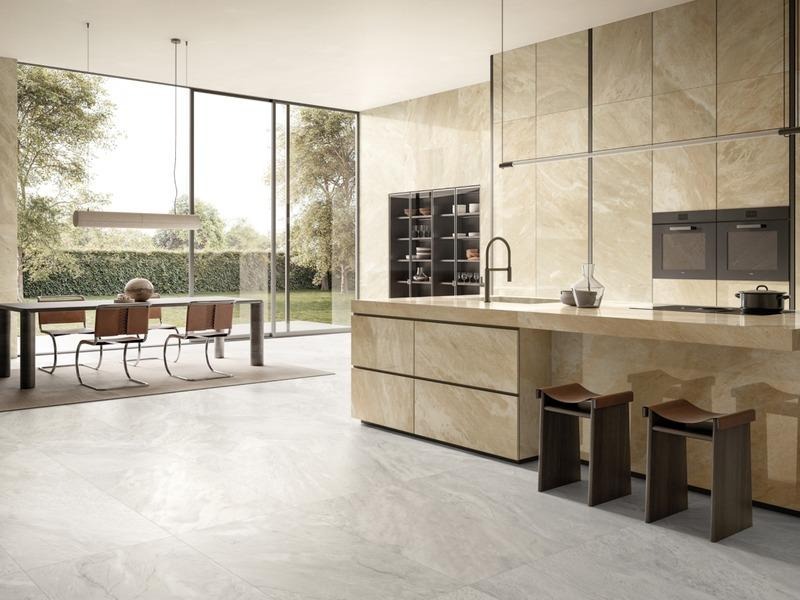
Tile size has a significant impact on spatial perception. Large format kitchen tiles are widely appreciated for their ability to create continuity. Reduced grout lines contribute to a cleaner, more expansive look, particularly effective in open plan kitchens.
In smaller spaces, carefully selected medium formats can provide balance without overwhelming the room. The direction of installation further influences how space is perceived. Linear layouts can elongate a kitchen, while more structured arrangements add subtle character.
Grout selection should be considered part of the design strategy. Tone on tone joints reinforce a seamless appearance, whereas contrasting grout can emphasise geometry. These details, though often underestimated, contribute greatly to the final aesthetic result.
Surface effects: balancing personality and longevity
Surface effect defines the character of a kitchen. Marble inspired finishes introduce a sense of refinement and timeless appeal, while stone effect surfaces convey warmth and natural authenticity. Concrete inspired tiles, on the other hand, lend a contemporary and architectural feel.
Neutral finishes remain particularly versatile, offering a backdrop that adapts to evolving furnishings and décor. The advantage of advanced ceramic materials lies in their ability to replicate natural aesthetics while providing greater consistency, durability and ease of maintenance.
Selecting a surface effect should therefore involve more than following current trends. It requires considering how the material will age within the broader context of the home.
Long term value: investing with foresight
Kitchen tiles are not a temporary feature. Replacing them involves significant intervention, making initial choices even more important. Durable, technically advanced materials reduce the need for future refurbishment and maintain their integrity over time.
Equally, timeless design decisions protect the overall value of the property. Balanced proportions, understated textures and adaptable colour palettes tend to remain relevant beyond seasonal trends.
Ultimately, choosing the right kitchen tiles means aligning technical performance with aesthetic clarity. When durability, proportion and design sensitivity are carefully integrated, the result is a kitchen that performs efficiently today and retains its appeal for years to come.
Ceramiche Refin: when surface becomes the structure of design
The quality of a space is measured by its ability to endure. Beyond aesthetics, it reflects a balance between material selection, design coherence, and technical reliability. In contemporary architecture, surfaces define proportions, modulate light, and shape atmosphere.
Within this context, Ceramiche Refin stands out. Founded in 1962 and part of the Concorde Group, the company has transformed more than six decades of expertise into a structured production model. Aesthetic research, technological development, and quality control are managed entirely in house, ensuring continuity between design vision and result while reinforcing a distinctive identity in Italian porcelain stoneware.
Its collections are conceived as versatile design tools for large contract projects as well as residential interiors applications, where visual coherence and performance must coexist.
The special project RELIEFS explores three dimensionality as an architectural value, transforming walls into dynamic surfaces. Six sculptural textures shape light through grooves and structured geometries, generating evolving chiaroscuro effects that add rhythm and depth.
INK develops a more expressive graphic language. Fluid gestures and immersive patterns unfold in 80×80 formats, modulating atmosphere according to light and distance. The palette ranges from refined neutrals to more intense accents, allowing for balanced yet distinctive spaces.
PRESTIGIO KALEIDOS offers a scenic, metamorphic interpretation of material. Reflections and chromatic nuances shift with changing light, evoking geological stratifications. Available in 120×120, 60×120, and 120×278 slab formats, in Matt and Glossy finishes, it expands compositional possibilities with coordinated decorative elements.
OSMOS embraces controlled imperfection, where subtle variations and material traces define its identity. From Calce to Ruggine, its tones create sober, sophisticated interiors while maintaining continuity between indoor and outdoor spaces.
From design to final production, the entire process takes place within the company’s facilities, guaranteeing traceability and consistent quality standards. Continuous research, technological innovation, and responsible manufacturing – focused on waste recovery, emission reduction, and resource optimization – confirm a vision where industrial precision, aesthetic depth, and environmental responsibility converge in a strong international presence.